Machinery operators and engineers frequently face a critical, often expensive challenge: finding a transmission system that delivers massive torque and precise stopping power without occupying excessive physical space. Standard spur or helical gear setups often fail to provide the necessary reduction ratios in a compact footprint, or they require complex external braking systems to hold heavy loads safely.
Here is the scary part… relying on an inadequate gearing system for vertical lifts or heavy steering applications can lead to catastrophic equipment failure. If a gear system cannot naturally hold a load when power is cut, you risk dangerous back-driving where the load crashes down or the steering wheel kicks back violently. Furthermore, the hidden costs of utilizing standard gears in high-torque environments manifest as spiraling maintenance fees due to rapid tooth wear and noise pollution.
The worm gear stands out as the robust engineering solution to these specific torque and safety dilemmas. By offering a unique self-locking mechanism and massive reduction ratios in a single stage, worm gears solve space and safety problems that other gears cannot touch. This guide explores exactly how worm gears work, their critical role in worm and worm wheel steering gear systems, and the specific maintenance protocols required to ensure decades of reliable service.
1. Mechanics of the Worm and Worm Wheel Steering Gear
What exactly is a worm gear?
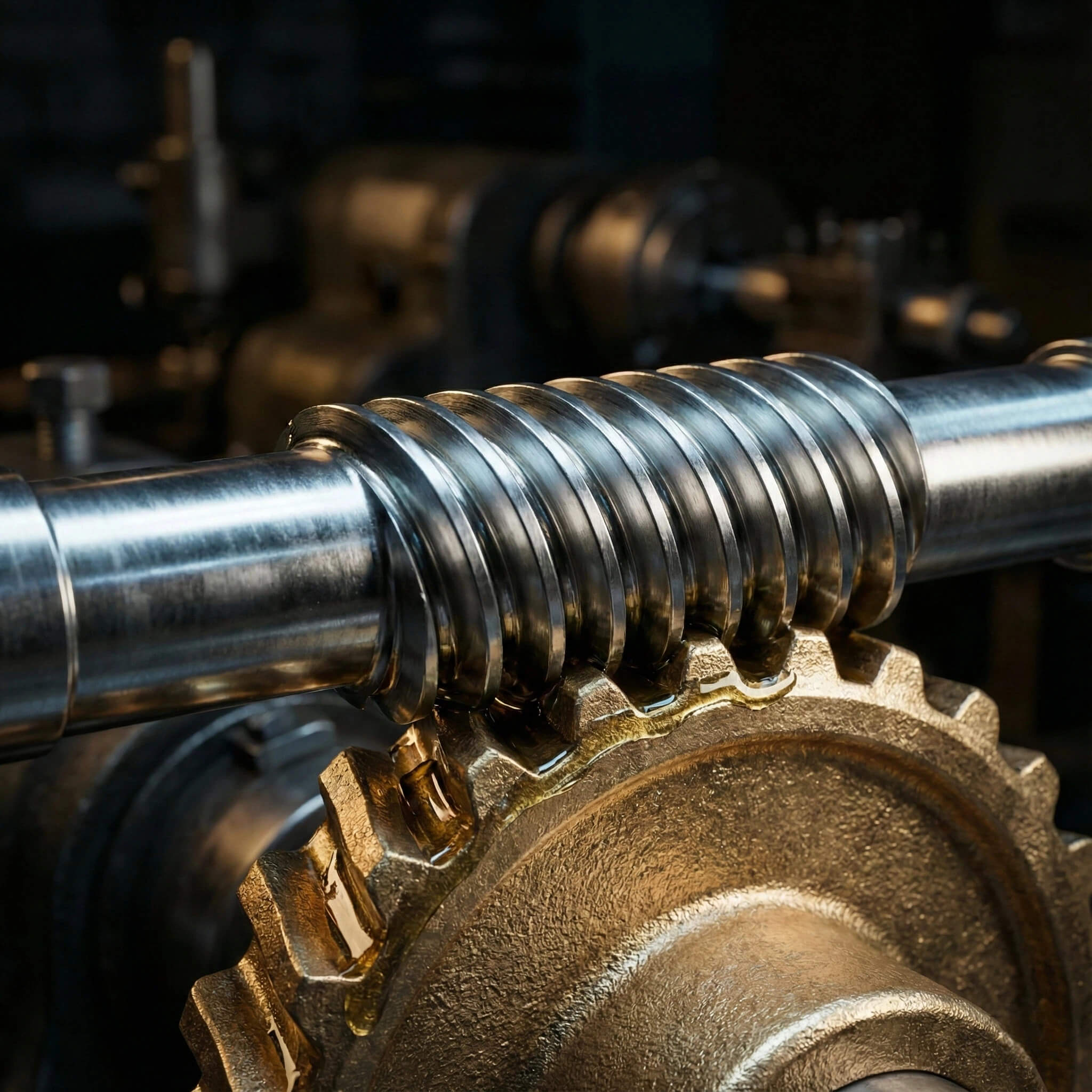
A worm gear is a specialized gear arrangement consisting of a screw-like shaft (the worm) that meshes with a toothed wheel (the worm wheel). This system transmits power between non-intersecting shafts, typically oriented at a 90-degree angle to one another. It is the industry standard mechanism for achieving significant speed reduction and torque multiplication in a single mechanical stage.
You might be wondering… what distinguishes this from a standard crossed-helical gear? The difference lies in the specific contact engineering.
- Shaft Orientation: Non-intersecting, typically 90 degrees.
- Reduction Capability: High ratios (e.g., 20:1 to 300:1) in a single pass.
- Footprint: Extremely compact relative to torque output.
How does the mechanism work?
Unlike standard spur gears that operate on rolling contact, the worm gear operates primarily on sliding contact. As the worm rotates, its spiral thread pushes against the flank of the worm wheel’s teeth, converting high-speed rotational motion into slow, high-torque angular movement. This is similar to how a bolt drives a nut, but in a continuous rotational cycle.
- Input: High-speed, low-torque rotation (via the Worm).
- Action: Sliding friction along the helix angle.
- Output: Low-speed, high-torque rotation (via the Wheel).
Why is the sliding action important?
The sliding contact creates a unique performance profile that naturally dampens vibration and shock loads, making worm gears significantly quieter than spur gears. However, this sliding action generates substantial friction and heat, demanding a robust tribological approach. Understanding this friction is key to predicting gear life, as the system relies heavily on the wedge effect of the lubricant.
- Noise: Smoother, quieter operation due to lack of impact forces.
- Thermal: High heat generation requiring dissipation.
- Lubrication: Absolute requirement for compounded or synthetic oils.
Key Takeaway: Understanding the sliding mechanics ensures you can deploy worm gears effectively in applications where noise reduction and shock absorption are more critical than raw energy efficiency.
2. Critical Materials in Worm Gear Systems
What makes up the assembly?
The system relies on two primary components encased in a rigid housing: the worm acts as the driver while the worm wheel acts as the driven component. The housing is not just a cover; it is a structural component that must rigidly support the bearings to maintain precise alignment under high axial thrust loads.
Here is the deal… the interaction between these two parts creates immense Hertzian stress.
- Worm: Typically hardened steel or case-hardened alloy (e.g., 8620 or 4140 steel).
- Worm Wheel: Typically Bronze, Brass, or specialized Aluminum-Bronze alloys.
- Bearings: Tapered roller bearings are often used to handle the high axial thrust.
Why use different metal types?
Engineers intentionally pair a hard steel worm with a softer bronze wheel to manage the high sliding friction, a design choice known as a “sacrificial mating pair.” The bronze wheel has a lower coefficient of friction against steel and helps prevent galling (cold welding) by microscopically wearing down to conform to the worm. If both components were hardened steel, the heat and pressure would cause immediate seizure.
- Hardened Steel Worm: Provides structural rigidity and resists thread wear.
- Bronze Wheel: Offers natural lubricity and acts as a sacrificial fuse.
- Dissimilarity: Prevents galling and lowers the risk of seizure.
How does quality affect longevity?
The longevity of the gearset is directly tied to the traceability of the raw materials and the precision of the heat treatment. Yantong Tech emphasizes that the specific alloy composition dictates load capacity, as low-quality porous bronze leads to rapid pitting. Furthermore, the steel worm must be ground to a precise surface finish to minimize abrasive wear on the bronze wheel.
- Material Certs: Certified reports verifying copper/tin ratios.
- Heat Treatment: Carburizing or nitriding the worm for surface hardness.
- Profile Grinding: ISO grade precision to ensure maximum contact area.
Table 1: Material Combination Comparison
| Component Pairing | Durability | Cost | Friction Coefficient | Typical Application |
|---|---|---|---|---|
| Steel Worm / Phosphor Bronze Wheel | High | High | Low | Heavy industrial lifts, Steering gears. |
| Steel Worm / Cast Iron Wheel | Medium | Low | High | Low-speed manual winches. |
| Steel Worm / Nylon or Plastic Wheel | Low | Low | Very Low | Light-duty automotive seats. |
Expert Analysis: While Steel-on-Plastic is quieter and cheaper, the industrial standard remains Case-Hardened Steel on Centrifugally Cast Phosphor Bronze because the bronze microstructure offers the highest resistance to pitting under continuous high-torque loads.
Key Takeaway: By verifying material traceability and selecting the correct steel-bronze combination, you ensure the long-term reliability of your machinery and avoid unexpected downtime caused by premature wheel stripping.
3. Structural Variations of Worm Drive Systems
What is a non-throated drive?
This is the most basic variation where a straight cylindrical worm meshes with a standard helical gear, resulting in theoretically single-point contact. Because the load is concentrated on this tiny point, non-throated gears have low power capacity and wear relatively quickly. They are typically found in light-duty applications where cost is the primary driver.
But it gets better… engineers developed “throated” designs to solve this contact limitation.
- Non-Throated Features: Simple manufacturing, point-contact limits.
- Load Capacity: Low; susceptible to rapid wear.
- Usage: Light instrumentation and simple adjustments.
How does double-enveloping differ?
In a double-enveloping design, the worm is shaped like an hourglass to wrap around the curvature of the wheel, while the wheel is throated to wrap around the worm. This creates a “line of contact” across multiple teeth simultaneously rather than a single point. This distribution of force allows double-enveloping gears to handle significantly higher loads than cylindrical worms.
- Surface Area: Maximum contact between teeth.
- Load Capacity: Highest torque density available.
- Durability: Excellent resistance to shock loading.
What determines the thread count?
The number of “starts” on the worm dictates the reduction ratio and efficiency. A single-start worm has one continuous thread where one 360° turn advances the wheel by one tooth, yielding the highest ratio. Multi-start worms have parallel threads, increasing speed and efficiency but reducing self-locking capabilities.
- Single-Start: High Ratio (e.g., 60:1), Self-Locking, Slower.
- Multi-Start: Lower Ratio (e.g., 10:1), Higher Efficiency, Faster.
- Lead Angle: Increases with more starts, improving efficiency.
Table 2: Worm Gear Types Comparison
| Type | Contact Area | Torque Capacity | Manufacturing Cost | Best For |
|---|---|---|---|---|
| Non-Throated | Point Contact | Low | Low | Light instrumentation. |
| Single-Throated | Line Contact | Medium | Medium | General industrial gearboxes. |
| Double-Enveloping | Area Contact | Very High | High | Heavy mining, steering gears. |
Expert Analysis: Although double-enveloping gears require a higher initial investment due to complex machining, their ability to withstand shock loads without tooth fracture makes them the most cost-effective choice for heavy industrial lifecycles.
Key Takeaway: Choosing the specific variation allows you to balance your project’s budget against the specific torque and durability requirements of the application.
4. The Worm and Worm Wheel Steering Gear Advantage
How does it aid vehicle steering?
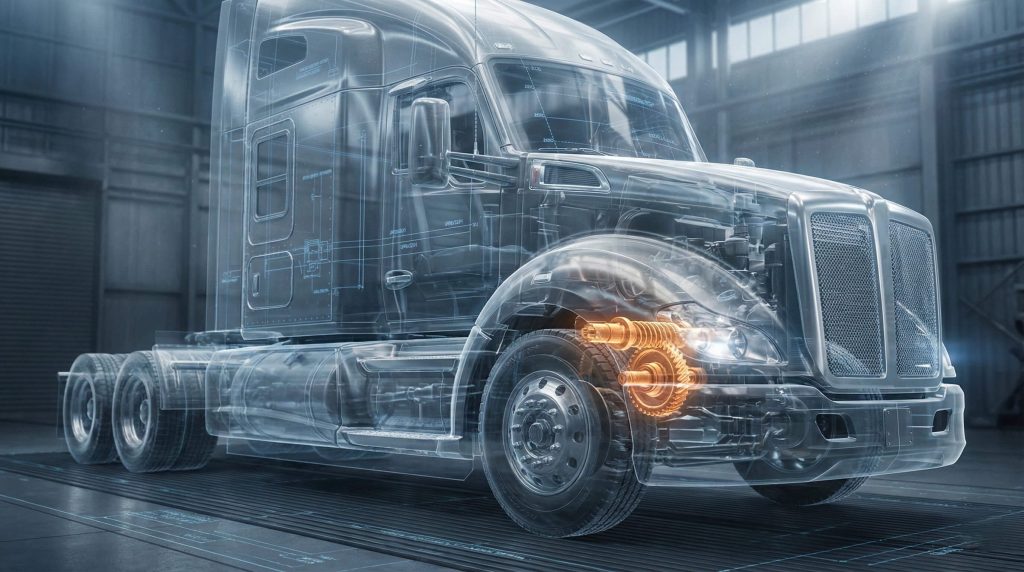
The worm and worm wheel steering gear mechanism converts the rotary motion of the steering wheel into the lateral motion required to turn a vehicle’s wheels. As the driver turns the steering shaft, the worm engages a sector gear attached to the pitman arm, which leverages the steering linkage.
Think about it this way… without this gear reduction, turning the wheels of a stationary semi-truck would require superhuman strength.
- Motion Conversion: Rotational input to linear output.
- Torque Multiplication: Allows human effort to turn massive tires.
- Precision: Fine thread pitch allows for accurate directional control.
Why use it in heavy trucks?
Heavy vehicles require immense force to turn the steer tires, especially at low speeds, and rack and pinion systems often lack the necessary durability. The recirculating ball variation of the worm gear is preferred because the massive contact area handles heavy axle loads with ease. This mechanical advantage also reduces the “kickback” a driver feels when hitting potholes.
- Shock Resistance: Absorbs road impact before it reaches the steering wheel.
- Durability: Handles high stress better than rack and pinion.
- Control: Provides a steady, non-twitchy steering feel.
Where else is this applied?
Beyond heavy trucks, this technology is standard in automated guided vehicles (AGVs), forklifts, and airport tugs. Variations like the Torsen differential use worm gears to manage torque splits between axles. Additionally, elevator braking systems utilize the self-locking properties of this design for safety holds.
- Recirculating Ball: Ball bearings reduce friction between worm and nut.
- Torsen Differentials: Torque management.
- Elevator Braking: Safety holds.
Key Takeaway: Utilizing worm and worm wheel steering gear technology provides you with the mechanical advantage and safety margins necessary for controlling heavy-duty automotive and industrial vehicles.
5. Key Benefits of Worm Gear Mechanisms
What is the self-locking feature?
One of the most valuable traits of the worm gear is self-locking, where the worm can drive the wheel, but the wheel cannot back-drive the worm. This occurs due to friction inherent in the sliding contact and the shallow lead angle of the threads. If a lift motor fails, the gear naturally holds the load in place, acting as a built-in safety brake.
Simply put… gravity cannot force the gear to turn backward.
- Requirement: Usually requires a lead angle of <5 degrees.
- Benefit: Eliminates the need for secondary braking systems in lifts.
- Caveat: Heavy vibration can sometimes break the friction lock.
How compact are they?
To achieve a 60:1 reduction ratio with spur gears, you would need a bulky gearbox with three separate stages. A worm gear achieves this same 60:1 ratio in a single stage with just two parts: the worm and the wheel. This makes them the only viable option for tight spaces like conveyor motor drives or robotics joints.
- Ratio: High reduction (up to 100:1) in a single stage.
- Geometry: Right-angle drive allows motor tucking.
- Simplicity: Fewer moving parts mean fewer points of failure.
Is the operation quiet?
Because the teeth slide into engagement rather than banging into each other like spur gears, worm gears are exceptionally quiet. This makes them ideal for applications in theaters, elevators, and hospitals where noise pollution is unacceptable. The oil film further aids in dampening vibration.
- Acoustic Profile: Smooth sliding engagement.
- Vibration Dampening: Via the oil film.
- Noise Level: Reduced high-frequency whining.
Table 3: Worm Gears vs. Spur Gears
| Feature | Worm Gear | Spur Gear |
|---|---|---|
| Efficiency | Lower (50-90%) | High (95-98%) |
| Noise Level | Low (Quiet sliding) | High (Impact noise) |
| Reduction Ratio | High (Single Stage) | Low (Multi-stage required) |
| Back-Driving | Self-Locking (Safety) | Easily Back-driven |
Expert Analysis: One sentence noting that while worm gears sacrifice some efficiency, their space-saving and self-locking properties are unmatched for vertical lifting and positioning.
Key Takeaway: You gain significant mechanical advantages in safety and space optimization, making these gears ideal for vertical lifting and precise positioning.
6. Efficiency and Heat in Worm Gear Units
Why do they generate heat?
The fundamental trade-off for the worm gear’s silence and high ratio is friction, as the sliding action converts a percentage of input power directly into heat. While a spur gear might be 98% efficient, a high-ratio worm gear might only be 60% efficient. This lost energy significantly heats up the gearbox housing and the lubricant.
- Friction: Sliding action creates thermal energy.
- Efficiency: Inversely related to the reduction ratio.
- Impact: Heats housing and degrades oil.
How does lead angle affect power?
Efficiency is mathematically tied to the lead angle, or the steepness of the worm thread. A flat angle results in high friction and self-locking capabilities but lower efficiency. Conversely, a steep angle offers better efficiency and higher speed but reduces the likelihood of self-locking.
It turns out that… you cannot have maximum efficiency and self-locking capabilities simultaneously.
- Flat Angle: High friction, self-locking.
- Steep Angle: Lower friction, higher efficiency.
- Balance: Engineered based on specific application needs.
Is cooling always necessary?
For continuous duty cycles, active cooling is often required because heat is the enemy of the bronze wheel. If the oil gets too hot, the film breaks, causing the steel worm to grind away the bronze. Housings are often designed with fins to increase surface area or utilize fans for heat dissipation.
- Fins: Increase surface area for cooling.
- Fans: Blow air over the casing.
- Oil: Synthetics operate better at higher temperatures.
Key Takeaway: Managing heat generation is the single most important factor in ensuring your gear system operates efficiently without failure.
7. Troubleshooting Worm and Worm Wheel Steering Gear
How often should you lubricate?
Lubrication is the lifeblood of a worm gear, and because of sliding friction, standard motor oil will fail. You must use Compounded Gear Oils or heavy ISO-grade synthetics that can withstand high pressure. Oil changes should be frequent to remove bronze particles that wear off during normal operation.
Don’t make this mistake… assuming “grease is grease,” as the wrong viscosity leads to immediate overheating.
- Viscosity: Typically high (ISO 460 or 680).
- Additives: Extreme Pressure (EP) additives (check bronze compatibility).
- Level: Must cover the mesh point but not fill the case.
What causes premature failure?
The number one killer of worm gears is misalignment. If the worm is not perfectly 90 degrees to the wheel, the load concentrates on the corner of the bronze teeth. This causes rapid “pitting” and eventual tooth breakage.
- Overheating: Oil breakdown leads to bronze wear.
- Misalignment: Uneven wear patterns.
- Overloading: Plastic deformation of bronze teeth.
Can you adjust for wear?
As the bronze wears, the space between the teeth opens up, resulting in “slop” at the steering wheel. Most worm gear housings allow for backlash adjustment via a set screw. However, overtightening this adjustment removes the necessary oil film space and can cause the box to seize.
- Step 1: Loosen locknut on sector shaft.
- Step 2: Tighten adjustment screw carefully.
- Warning: Overtightening causes instant seizure.
Table 4: Troubleshooting Common Issues
| Symptom | Likely Cause | Recommended Solution |
|---|---|---|
| Overheating | Low oil / Wrong viscosity | Drain and refill with compounded worm oil. |
| Excessive Noise | Bearing failure or lack of oil | Check bearings for play; verify oil level. |
| Steering “Slop” | Excessive backlash | Adjust sector shaft screw (carefully). |
| Bronze Particles | Normal wear vs. Misalignment | Fine dust is normal; flakes indicate failure. |
Expert Analysis: A strict lubrication schedule is the cheapest insurance policy available; replacing a quart of synthetic oil costs $30, while rebuilding a seized worm gearbox costs thousands in parts and downtime.
Key Takeaway: Proactive maintenance protocols will drastically reduce downtime and prevent the expensive replacement of bronze worm wheels.
Conclusion
Understanding the mechanics of a worm gear transforms it from a simple component into a strategic asset for your machinery. Whether utilized in worm and worm wheel steering gear systems for heavy vehicles or in precision industrial lifts, these gears offer an unrivaled combination of torque density, safety, and compactness.
However, the difference between a working machine and costly downtime often lies in the quality of the manufacturing. Yantong Tech positions itself not just as a factory, but as a manufacturing partner for engineers who value stability. By combining ISO-grade precision grinding with a transparent, engineer-led communication process, they ensure that your gears are delivered with the documentation and reliability European and American markets demand.
For a solution that balances cost-effectiveness with strict quality control, consider a partner who prioritizes your equipment’s lifecycle.
Ready to optimize your machinery’s performance? Contact our engineering team today to find the precise worm gear solution for your needs.
Frequently Asked Questions (FAQs)
1. Can I use standard motor oil in a worm gearbox?
No, never. Standard motor oils lack the viscosity and specific “tackiness” additives required to withstand the high sliding friction of a worm drive. Using them will allow the oil film to break, leading to metal-to-metal contact, rapid wear of the bronze wheel, and eventual seizure.
2. What’s the best way to determine if my worm gear is self-locking?
Check the lead angle. As a general engineering rule, if the lead angle on the worm is less than 5 degrees, the gear is considered self-locking and cannot be back-driven by the load. However, safety regulations often dictate that you should not rely solely on this for lifting humans, as vibration can lower the friction coefficient momentarily.
3. How do I know if the bronze wheel needs replacement?
Inspect the oil and the teeth. If your oil change reveals large bronze flakes or “glitter,” the wheel is failing. Visually, look for signs of “pitting” on the tooth surface or excessive backlash in the system that cannot be adjusted out, indicating the sacrificial bronze material has worn down beyond tolerance.
4. Can I run a worm gear in reverse?
It depends on the definition. The input motor can certainly reverse direction to drive the load up or down. However, if you mean “can the output shaft drive the input shaft,” the answer is generally no for single-start worms due to self-locking physics.