
Introduction
Machinery breakdowns caused by worn transmission components are among the most frustrating and costly challenges in industrial manufacturing. When a critical worm gear fails in a packaging line or an automated conveyor, the immediate result is unplanned downtime that bleeds revenue with every passing hour. The situation worsens when the original equipment manufacturer (OEM) has discontinued the part, leaving procurement managers scrambling to find specifications for a machine built twenty years ago.
Installing a generic, low-quality replacement often leads to a cycle of repeated failures, as poor material composition and inaccurate geometry destroy the mating shaft within months. You need a solution that replicates the original engineering, not just the approximate shape.
Yantong Tech eliminates this uncertainty by utilizing advanced reverse engineering and precision manufacturing to deliver replacement worm gears that match or exceed original specifications. With over 15 years of experience in high-precision transmission components, we ensure that every gear set is manufactured with traceable 20CrMnTi steel and certified bronze alloys. We guarantee the peace of mind that global engineers demand.
What Are the Main Components of a Worm Gear?
Why Does Geometry Matter?
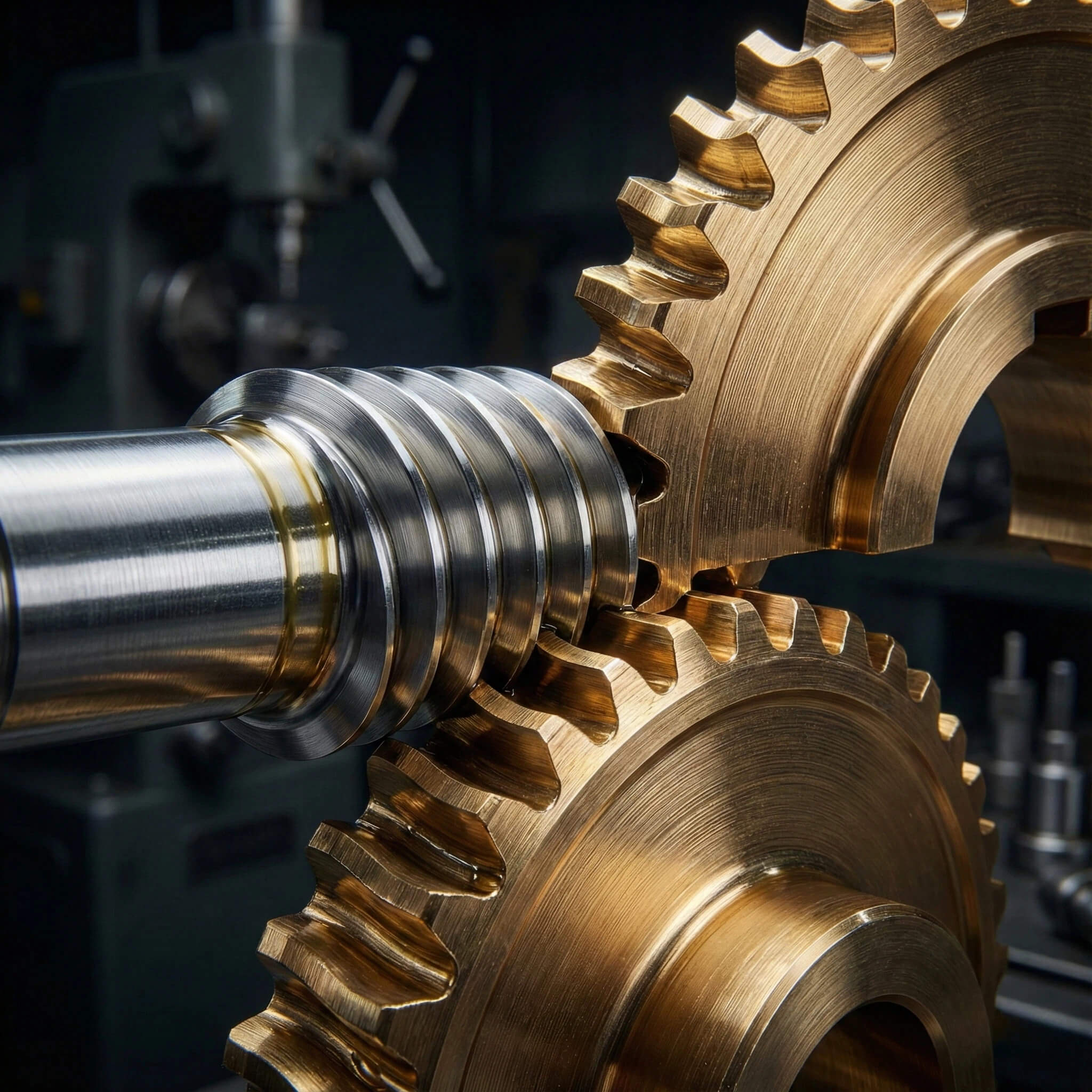
To understand why specific worm gears fail while others run for a decade, you must look inside the gearbox at the metallurgy and geometry of the components. A worm gear set is not a single unit but a mating pair that relies on a specific hardness differential to function correctly. If any element deviates from the engineering standard, the entire system collapses.
The assembly relies on strict alignment of the following parts:
- The Worm (Input Shaft): The screw-like driving component.
- The Worm Wheel (Output Gear): The toothed wheel that meshes with the worm.
- Housing and Bearings: Critical supports that maintain rigid alignment.
How Hard Should the Worm Be?
The worm acts as the driving component and typically resembles a threaded screw. Here is the critical part: The worm must be significantly harder than the wheel it drives to prevent immediate failure. At Yantong Tech, we manufacture worms using high-grade alloy steels such as 20CrMnTi or 18CrNiMo7-6.
To ensure durability, we focus on these specific metallurgical properties:
- Surface Hardness: 58–62 HRC achieved through carburizing heat treatment.
- Case Depth: Verified depth to handle high-pressure sliding contact.
- Resistance: Capable of withstanding shock loads without cracking.
Why Is the Wheel Bronze?
Conversely, the worm wheel serves as the sacrificial component in the assembly. It is typically manufactured from bronze alloys, such as CuSn12Ni or aluminum bronze, depending on the load requirements. The choice of bronze is deliberate because using two hard metals would generate immense heat and lead to immediate seizure.
We utilize centrifugal casting to ensure the following structural benefits:
- Lubricity: Soft bronze allows for a small amount of “bedding in.”
- Density: A grain structure free from air pockets found in sand-cast gears.
- Fatigue Resistance: Integrity vital for preventing tooth failure in heavy-duty apps.
| Component | Common Material | Hardness Standard | Primary Function |
|---|---|---|---|
| Worm Shaft | 20CrMnTi / 18CrNiMo7-6 | 58–62 HRC (Case Hardened) | Transmits input power; resists high sliding wear. |
| Worm Wheel | Bronze (CuSn12Ni) / Al-Bronze | 90–120 HB (Brinell) | Transmits output torque; acts as sacrificial wear surface. |
| Housing | Cast Iron / Aluminum | N/A | Maintains rigid alignment to prevent backlash variance. |
| Bearings | Chrome Steel | 60-64 HRC | Supports axial thrust loads generated by the worm. |
Expert Analysis: The hardness differential between the steel worm (approx 60 HRC) and bronze wheel (approx 100 HB) is the single most critical factor in preventing cold welding during operation.
Key Takeaway:
A worm gear system relies on a precise hardness differential between a case-hardened steel worm and a sacrificial bronze wheel. Deviating from these metallurgical standards leads to rapid wear or seizure. Yantong Tech ensures material traceability to prevent these costly mismatches.
How Does a Worm Gear Work?
How Does Sliding Contact Work?
The mechanics of a worm gear differ fundamentally from standard spur or helical gears, which primarily utilize rolling contact to transfer power. In a worm drive, the power transmission occurs through a continuous sliding action across the gear teeth. As the worm rotates, its spiral threads push against the angled teeth of the worm wheel, driving it forward.
This unique interaction results in distinct operational characteristics:
- Quiet Operation: Sliding contact is significantly quieter than rolling contact.
- Heat Generation: Friction generates heat, necessitating high-viscosity lubrication.
- Shaft Orientation: Almost always occurs between non-intersecting 90-degree shafts.
Can You Achieve High Ratios?
One of the most distinct mechanical features of this system is the potential for high reduction ratios in a single stage. While a standard spur gear set might achieve a 3:1 reduction, a worm gear can easily achieve ratios ranging from 5:1 up to 100:1. This capability allows engineers to step down high motor speeds without multiple gear stages.
The reduction ratio is determined by a simple calculation:
- Formula: Teeth on the worm wheel divided by starts on the worm.
- Example: A 60-tooth wheel driven by a single-start worm yields a 60:1 reduction.
- Benefit: Saves immense amounts of physical space in machinery design.
Is Self-Locking Reliable?
A worm gear is considered self-locking if the worm can drive the wheel, but the wheel cannot drive the worm in reverse. This occurs when the friction angle between the materials is greater than the lead angle of the worm threads. It is a desirable feature for preventing loads from free-falling.
But there is a catch: The phenomenon known as “self-locking” is often misunderstood and should not be relied upon as a primary brake.
You must consider these safety factors regarding self-locking:
- Vibration: Can lower friction coefficients and cause slipping.
- Surface Polishing: Wear over time reduces the holding capability.
- Requirement: Critical applications like elevators must always use a mechanical brake.
| Parameter | Description | Impact on Operation |
|---|---|---|
| Sliding Contact | Teeth slide rather than roll. | Results in quiet operation but requires ISO 320+ oil. |
| Reduction Ratio | Teeth on Wheel ÷ Starts on Worm. | Allows compact speed reduction (e.g., 60:1 in one box). |
| Self-Locking | Inability to back-drive. | Provides holding capability but is not a fail-safe brake. |
| Lead Angle | Angle of the worm thread. | Lower angles increase self-locking but decrease efficiency. |
Expert Analysis: While self-locking is a useful characteristic, relying on it for safety in lifting applications violates modern engineering safety standards; a physical brake is always mandatory.
Key Takeaway:
Worm gears offer high reduction ratios and quiet operation through sliding contact, but they generate significant heat. While many are theoretically self-locking, Yantong Tech advises that external brakes are essential for safety-critical applications due to friction variances.
What Are the Different Types of Worm Gears?
What Is a Non-Throated Gear?
The first type is the Non-Throated, or Cylindrical, worm gear configuration. In this design, the worm is a simple screw, and the gear is a standard helical gear with no concave curve on either part. The contact between the teeth is a mere point, which severely limits the load capacity.
This type is generally defined by:
- Geometry: Straight worm and straight wheel.
- Contact: Single point contact.
- Application: Old machinery or light-duty adjusters.
Why Use Single-Throated Gears?
The most common industrial variant is the Single-Throated worm gear. Here, the worm wheel is concave, curving around the worm to wrap partially around its circumference. This modification changes the contact from a single point to a line of contact.
Yantong Tech manufactures these to ISO 1328 Grade 6 precision to ensure:
- Load Capacity: Drastic increase due to larger contact area.
- Durability: Resistant to stripping under industrial stress.
- Alignment: Centered “line of contact” prevents edge loading.
When Do You Need Double-Throated?
Finally, there is the Double-Throated (Globoidal or Hourglass) worm gear. In this advanced design, the worm is also concave, shaped like an hourglass to wrap around the curvature of the wheel. What is the real story? These are the kings of torque density used in the heaviest applications.
However, they require specific attention to detail:
- Contact Area: Distributes load over multiple teeth simultaneously.
- Application: Mining crushers and precision rotary tables.
- Installation: Requires extremely precise 5-axis axial alignment.
| Gear Type | Geometry Characteristics | Contact Pattern | Typical Application |
|---|---|---|---|
| Non-Throated | Cylindrical worm, straight wheel. | Point Contact | Light instruments, manual adjusters. |
| Single-Throated | Cylindrical worm, concave wheel. | Line Contact | General industrial conveyors, mixers. |
| Double-Throated | Hourglass worm, concave wheel. | Area Contact | Heavy crushers, precision indexing. |
Expert Analysis: Double-throated gears offer the highest torque density but are the most unforgiving regarding installation alignment; Single-throated remains the industry standard for general automation.
Key Takeaway:
Identifying whether your gear is non-throated, single-throated, or double-throated is critical for sourcing the correct replacement. Single-throated gears cover most industrial needs, while Yantong Tech offers specialized double-throated solutions for high-torque requirements.
Where Are Worm Gears Used in Industry?
Why Use Them in Packaging?
In the Packaging and Food Processing sectors, worm gears are ubiquitous. Consider a bottling line or a pharmaceutical blister pack machine where precise speed control is needed to synchronize the movement of fragile products. More importantly, they require cleanliness and low noise levels.
Yantong Tech supports these environments with:
- Hygiene: Sealed, leak-proof gearbox solutions.
- Silence: Smooth sliding contact reduces noise pollution.
- Protection: Precision surface finishes to ensure lip seals function perfectly.
Are They Safe for Lifting?
In Lifts, Hoists, and Elevators, the worm gear is a safety-critical component. The ability to hold a load without a brake acts as a primary safety layer during operation. Why does this matter? It prevents catastrophic free-fall if the motor power cuts out while lifting a heavy load.
We ensure safety in these sectors through:
- Holding Power: Prevents the load from back-driving the motor.
- Testing: Magnetic particle inspection (MPI) to detect micro-cracks.
- Reliability: Mechanical assurance that keeps operators safe.
Do Robots Need Worm Gears?
Automation and Robotics also rely heavily on worm gears, particularly for rotary tables and joint movements. Here, the focus shifts from pure power to absolute precision. A robot arm needs to stop at an exact coordinate every time without jittering.
To meet these high-tech demands, we provide:
- Low Backlash: Minimized play between teeth for accuracy.
- Repeatability: Consistent stopping for welding or assembly tasks.
- Customization: Profiles adjusted to minimize center distance variance.
Key Takeaway:
From hygienic food processing lines to safety-critical elevators and precise robotics, worm gears are indispensable. Yantong Tech tailors the manufacturing process—whether sealing for hygiene or MPI testing for safety—to meet the specific demands of these diverse industries.
What Are the Pros and Cons of Worm Gears?
What Are the Main Advantages?
Engineers prioritize transparency, and understanding the benefits is key to proper application. The primary benefit is the massive reduction ratio available in a tiny footprint. Replacing a worm gear with a spur gear train would require a gearbox three times the size.
The standout advantages include:
- Compactness: High ratios (up to 100:1) in a single stage.
- Noise Reduction: Sliding mesh cushions impact for quiet operation.
- Shock Absorption: Bronze wheel protects the drivetrain from jamming.
What Are the Disadvantages?
But here is the catch: The disadvantages largely stem from the friction that makes them work. Sliding friction is less efficient than rolling friction, often resulting in only 60-80% efficiency compared to helical gears. This lost energy translates directly into heat.
You must be aware of these limitations:
- Efficiency: Lower power transmission efficiency.
- Heat: Requires careful thermal management and cooling.
- Wear: Sacrificial bronze wheels require eventual replacement.
How Can You Mitigate Wear?
Yantong Tech mitigates these issues by helping clients choose the right materials and lubricants. Using synthetic lubricants (PAG or PAO based) can significantly improve efficiency and reduce wear. Additionally, using premium tin-bronze alloys extends service intervals.
We recommend the following mitigation strategies:
- Lubrication: Use synthetic ISO 320/460 oil to manage heat.
- Inspection: Check backlash annually to monitor wear.
- Material: Select quality alloys for the best balance of lubricity.
| Feature | Advantage | Disadvantage | Mitigation Strategy |
|---|---|---|---|
| Drive Mechanism | Compact high ratio (up to 100:1). | High sliding friction leads to heat. | Use synthetic ISO 320/460 oil. |
| Material Pair | Quiet operation; shock absorption. | Bronze wheel eventually wears out. | Inspect backlash annually; use quality alloy. |
| Geometry | 90-degree power transfer. | Lower efficiency (60-80%). | Ensure proper cooling/ventilation. |
Expert Analysis: The trade-off for high reduction in a small space is heat generation; upgrading to synthetic oil is the most cost-effective way to extend the life of a worm gear unit.
Key Takeaway:
Worm gears offer unmatched compactness and quiet operation but suffer from lower efficiency and heat generation. By utilizing synthetic lubricants and Yantong Tech’s premium bronze alloys, you can mitigate wear and maximize the lifespan of your equipment.
How Do You Choose a Replacement Worm Gear?
What Are the Signs of Failure?
Sourcing a replacement is rarely simple, so understanding the signs of failure is vital for restoring production. You do not want to wait until the teeth strip completely before taking action. Early detection can save the mating components from damage.
Watch for these specific warning signs:
- Noise: A grinding or “gravelly” sound indicates surface damage.
- Backlash: Excessive play before the output shaft moves.
- Oil Condition: Glittering gold-colored flakes indicate bronze deterioration.
Does Off-the-Shelf Fit?
Here is the reality: Most off-the-shelf gears will not fit your specific housing or shaft requirements. Often, the machine is old, the nameplate is faded, and the original manufacturer is out of business. This leaves maintenance teams in a precarious position.
You are often faced with these challenges:
- Obsolescence: OEM parts are no longer available.
- Lead Times: Original quotes may be 12 weeks or more.
- Fitment: Generic parts often require expensive machine mods.
How Does Reverse Engineering Work?
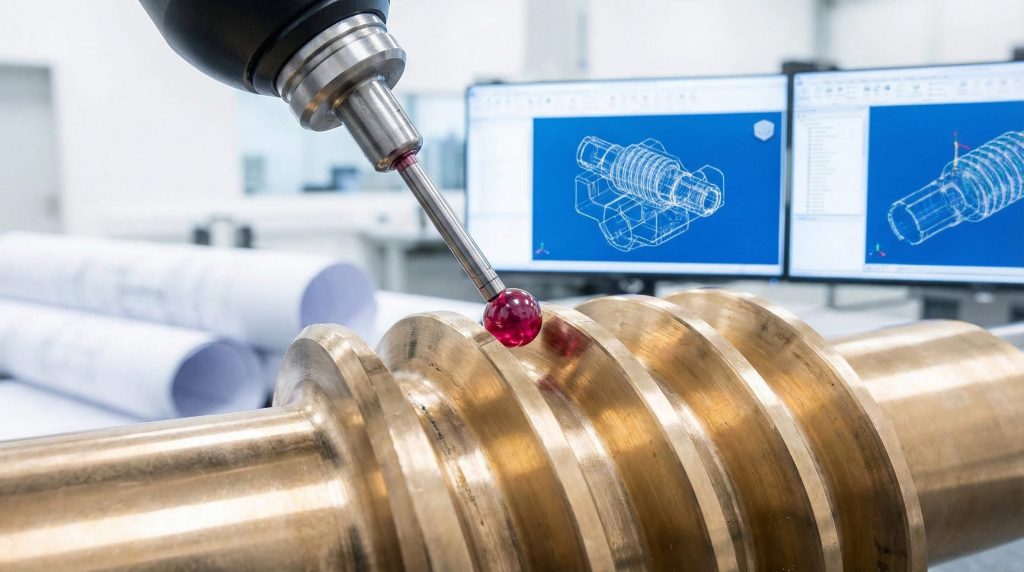
This is where Reverse Engineering becomes the engineer’s best friend. Yantong Tech specializes in this service, allowing you to send us the worn sample even if it is damaged. We utilize Coordinate Measuring Machines (CMM) to map the geometry of the remaining teeth.
Our process delivers a better-than-new solution:
- Analysis: Spectrometry identifies the exact alloy composition.
- Optimization: We improve micro-geometry for better contact patterns.
- Traceability: You receive reports verifying heat treatment and hardness.
| Observation | Probable Cause | Recommended Action |
|---|---|---|
| Grinding Noise | Pitting or surface damage. | Stop machine; inspect gear teeth immediately. |
| Golden Flakes in Oil | Bronze wheel wear. | Check alignment; replace gear set if backlash is high. |
| Overheating | Lack of lubrication or overload. | Check oil level/type; verify load capacity. |
| Excessive Play | Tooth thinning (wear). | Measure backlash; prepare for replacement. |
Expert Analysis: Physical samples are superior to drawings for old machinery; wear patterns on the old gear often reveal alignment issues that we can correct in the new design.
Key Takeaway:
Don’t risk generic parts that don’t fit. Yantong Tech’s reverse engineering service transforms your worn, obsolete sample into a precision-manufactured replacement, often with optimized geometry and superior materials for longer service life.
Conclusion
While the worm gear may seem like a simple mechanical device, its performance is governed by a complex interplay of metallurgy, friction physics, and geometric precision. A well-manufactured worm gear acts as the silent, reliable heart of your machinery, delivering high torque and safety for years. However, a sub-par component—manufactured with inferior bronze or improperly hardened steel—is a ticking time bomb for your production line.
At Yantong Tech, we understand that you are not just buying a gear; you are buying reliability. Whether you need a standard replacement or a custom reverse-engineered solution for an obsolete machine, our engineering-first approach ensures you get a component that fits perfectly and lasts longer.
Ready to eliminate downtime?
Stop searching for discontinued parts. Contact Yantong Tech today to discuss your specifications, and let us manufacture the precision worm gear replacement your machinery deserves.
FAQ
Can I replace just the worm wheel and keep the old shaft?
No, it is generally not recommended. The worm and wheel wear together to establish a unique contact pattern. Installing a new bronze wheel with an old, worn steel worm allows imperfections on the old worm to act like a file, rapidly destroying the new wheel.
What is the most common cause of worm gear failure?
Lubrication breakdown is the primary culprit. Due to high sliding friction, worm gears generate significant heat. If the oil level is low, viscosity is incorrect, or oxidation occurs, the protective film breaks down, leading to rapid metal-on-metal wear.
How do I identify the ratio of my worn gear?
You can calculate the ratio by counting physical features. Count the teeth on the bronze wheel and the number of thread starts on the worm (independent grooves, not length). Divide the wheel teeth by the worm starts (e.g., 40 teeth / 2 starts = 20:1 ratio).
Can I get a custom replacement if I don’t have drawings?
Yes, absolutely. Yantong Tech specializes in reverse engineering. You can send us the worn or damaged sample, and we will use CMM technology and spectrometry to derive the exact geometry and material specifications for a perfect replacement.
Why is the bronze material specification so important?
The alloy determines the gear’s ability to withstand friction. Bronze that is too soft deforms under torque, while bronze that is too hard fails to lubricate the steel shaft. We use certified alloys like CuSn12Ni to ensure the perfect balance of strength and lubricity.