
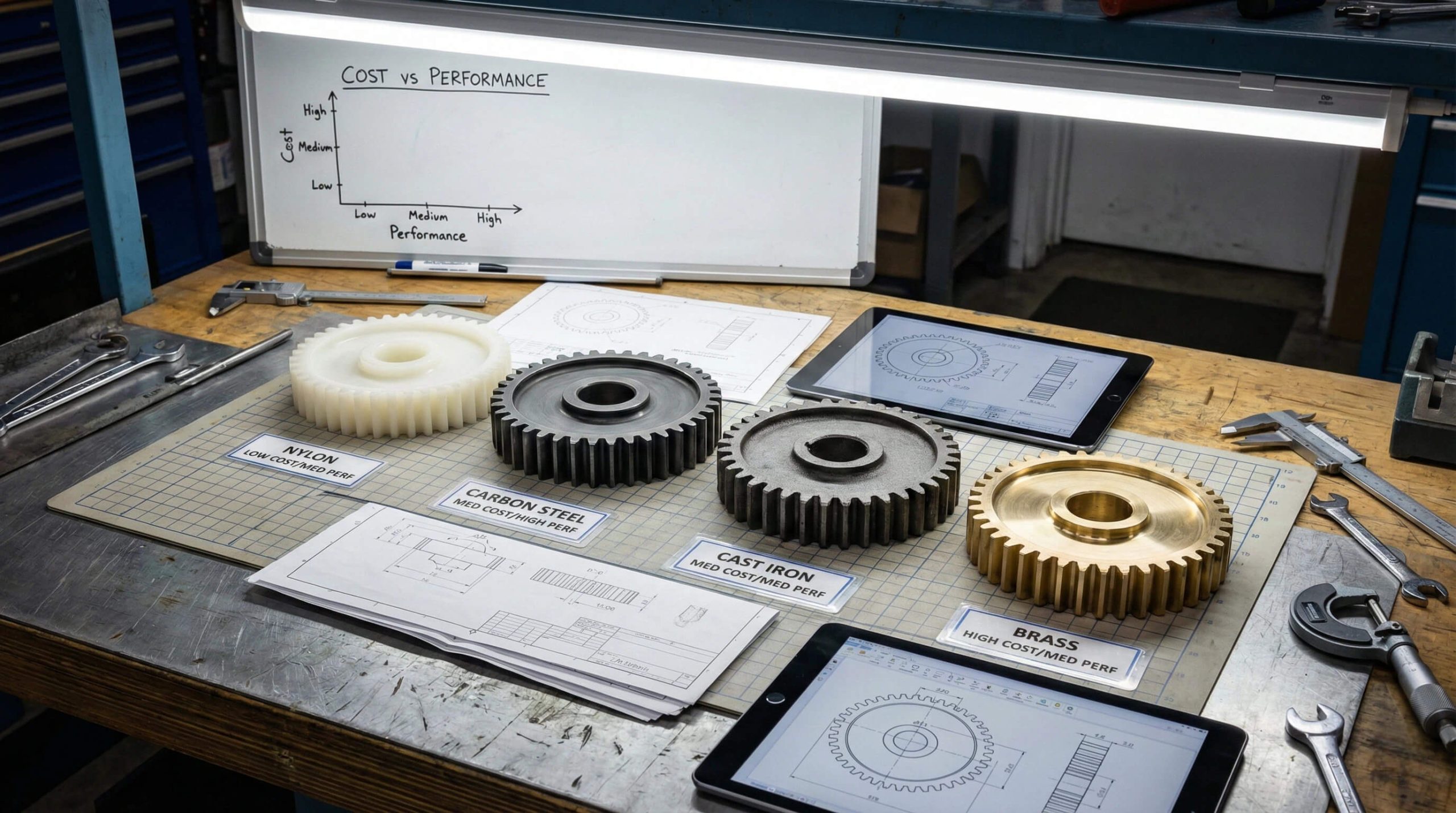
The four most economical spur gear materials are Nylon, Carbon Steel, Cast Iron, and Brass, which provide reliable performance while significantly reducing manufacturing costs.
You are likely struggling with rising production costs and shrinking profit margins in your latest engineering project. Every component seems to demand a high-end price tag that simply does not fit your operational budget.
Overspending on premium alloys for standard applications is a common trap that drains your capital quickly. Choosing the right spur gear materials allows you to maintain industrial-grade reliability while slashing your procurement expenses.
Why is selecting spur gear materials critical for your budget?
Selecting the right substrate determines whether you pay for actual performance or simply over-engineer a system unnecessarily. Raw material costs often represent the largest variable in your manufacturing bill of materials.
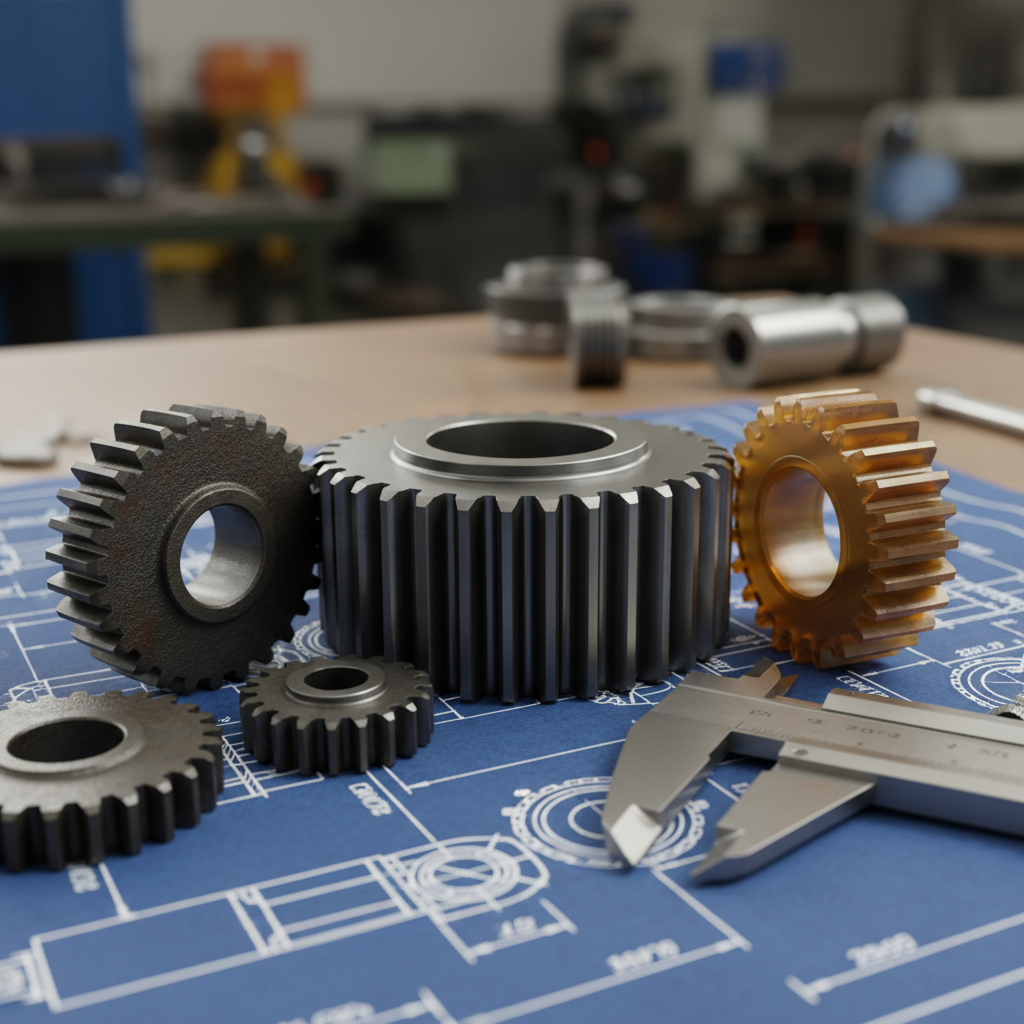
How does material choice impact your ROI?
Think about it: most light-duty systems do not require aerospace-grade titanium to function for a decade. Using affordable substrates ensures you meet safety factors without wasting liquidity on features your machine never utilizes.
● Lower raw material acquisition costs.
● Reduced machining and labor time.
● Minimal need for expensive secondary coatings.
Key Takeaway
Smart procurement starts with matching the mechanical load to the least expensive material that meets the required safety factor.
| Selection Factor | Budget Impact | Practical Benefit |
|---|---|---|
| Raw Cost | High | Immediate savings on bulk orders |
| Machinability | Medium | Lower labor costs per unit |
| Durability | Low | Balanced lifecycle expenses |
Analyzing your specific torque requirements prevents the common mistake of buying more strength than you actually need.
Is Nylon the most versatile of all spur gear materials?
Nylon stands out as a top contender for low-noise and self-lubricating industrial applications within your spur gear materials strategy. This polymer handles moderate loads while operating much more quietly than traditional metal alternatives.
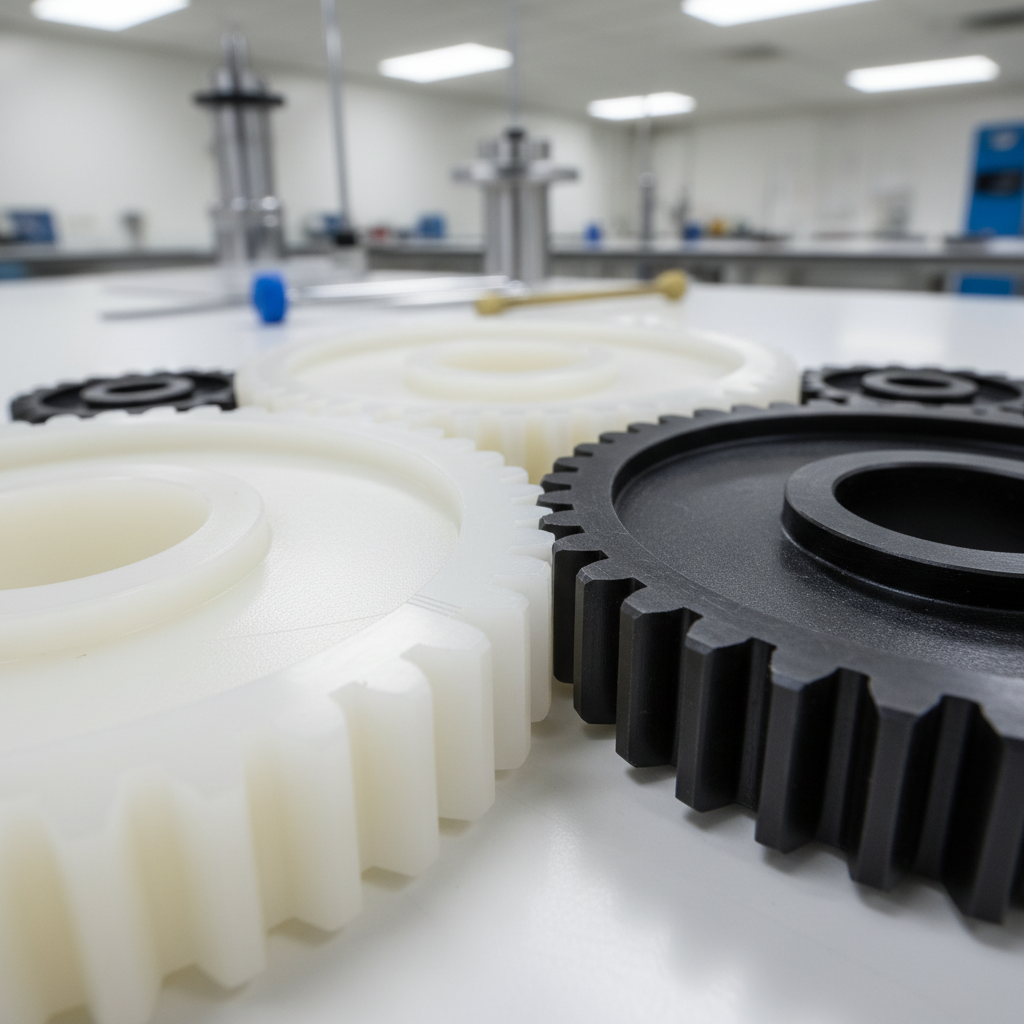
Why is self-lubrication a cost saver?
Here is the deal: maintenance labor and lubricant purchases add up to significant overhead over the life of a machine. Nylon gears eliminate the need for constant oiling in many automation environments.
● Reduced downtime for routine maintenance.
● Lower risk of contamination in food-grade lines.
● Exceptional resistance to chemicals and moisture.
Key Takeaway
Nylon provides a quiet, maintenance-free solution that reduces the total cost of ownership by eliminating external lubrication needs.
| Property | Industrial Nylon | Standard Steel |
|---|---|---|
| Lubrication | Self-Lubricating | Requires Oil/Grease |
| Noise Level | Very Low | Moderate to High |
| Weight | Light | Heavy |
Reviewing the environmental conditions helps you decide if a polymer-based system is appropriate for your operating temperatures.
How does Carbon Steel dominate metallic spur gear materials?
Carbon steel provides the best strength-to-cost ratio for high-torque mechanical systems across various industrial sectors. It is the workhorse of the gear world because it remains widely available and relatively easy to process.
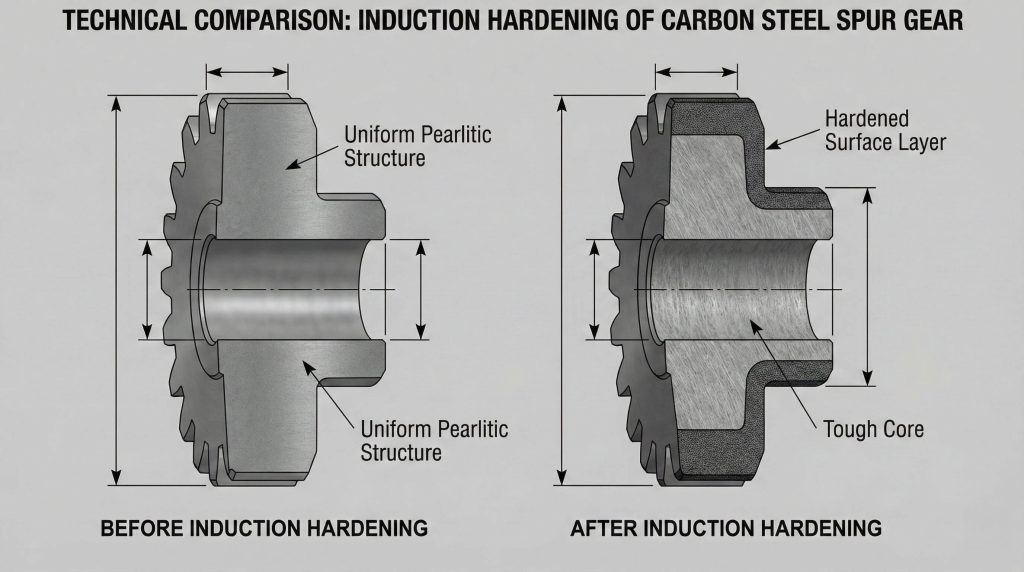
Can heat treatment improve carbon steel value?
Ready for the good part? You can significantly increase the surface hardness of carbon steel through simple induction processes. This allows a cheap material to mimic the wear resistance of much more expensive alloys.
● High tensile strength for heavy loads.
● Excellent response to surface hardening.
● Global availability in various stock sizes.
Key Takeaway
Carbon steel is the premier choice when you need maximum torque capacity without moving into the price range of exotic stainless alloys.
| Grade | Cost Rating | Strength Rating |
|---|---|---|
| AISI 1020 | Lowest | Moderate |
| AISI 1045 | Low | High |
| Alloy Steel | High | Extreme |
Choosing standard carbon grades allows your production team to utilize existing tools without investing in specialized cutters.
Why is Cast Iron preferred for heavy-duty spur gear materials?
Cast iron offers incredible compressive strength and vibration damping for large machinery in your spur gear materials inventory. It is particularly effective for slow-moving, heavy gears where bulk is an advantage rather than a drawback.
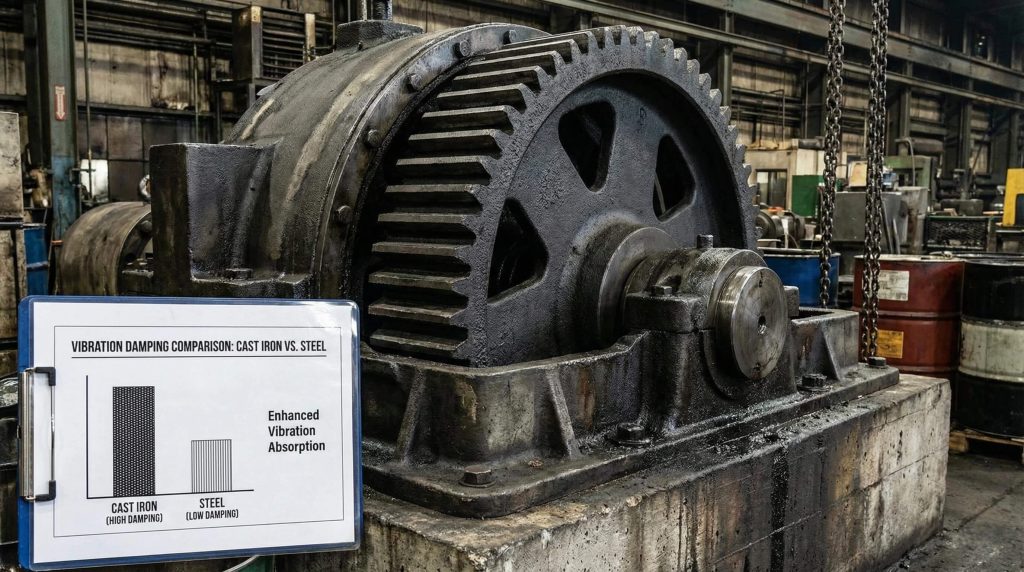
Does vibration damping extend machine life?
What’s the real story? Excessive vibration leads to premature bearing failure and system fatigue. Cast iron absorbs these shocks better than steel, protecting the rest of your expensive drive train.
● Superior internal damping characteristics.
● High resistance to surface galling.
● Low cost for large-volume components.
Key Takeaway
Cast iron is the most economical solution for large-scale industrial gears where weight is not a primary concern.
| Iron Type | Damping Ability | Cost Level |
|---|---|---|
| Gray Iron | Highest | Lowest |
| Ductile Iron | High | Moderate |
| Cast Steel | Moderate | High |
Evaluating the physical size of your gear train will often lead you toward cast iron for larger, stationary installations.
When should you use Brass for your spur gear materials?
Brass is the ideal choice for small precision gears that require corrosion resistance and low-friction contact. It is often used in instruments and small appliances where steel would be too prone to rust or magnetic interference.
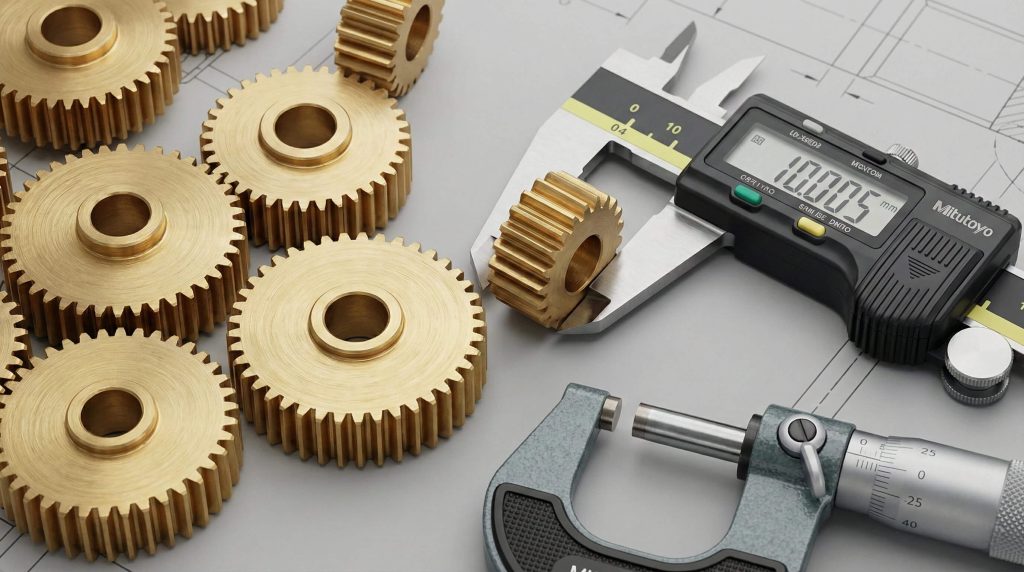
Is brass easier to machine than steel?
The best part? Brass has a very high machinability rating, which means your CNC cycles will be much faster. Faster cycle times translate directly into lower labor costs for every part produced.
● Natural resistance to atmospheric corrosion.
● High thermal conductivity for heat removal.
● Excellent aesthetic finish for visible gears.
Key Takeaway
Brass serves as a cost-effective alternative to stainless steel for small, precise components that must resist environmental degradation.
| Material | Machinability | Rust Resistance |
|---|---|---|
| Brass | Excellent | Very High |
| Carbon Steel | Good | Low |
| Stainless Steel | Fair | Extreme |
Consider the speed of your production run when deciding if the machinability of brass outweighs its higher raw metal cost.
Is Stainless Steel one of the budget spur gear materials?
While pricier than basic carbon steel, stainless steel remains a budget-friendly way to avoid rust in your spur gear materials selection. It eliminates the need for expensive plating or frequent replacement due to oxidation in wash-down environments.
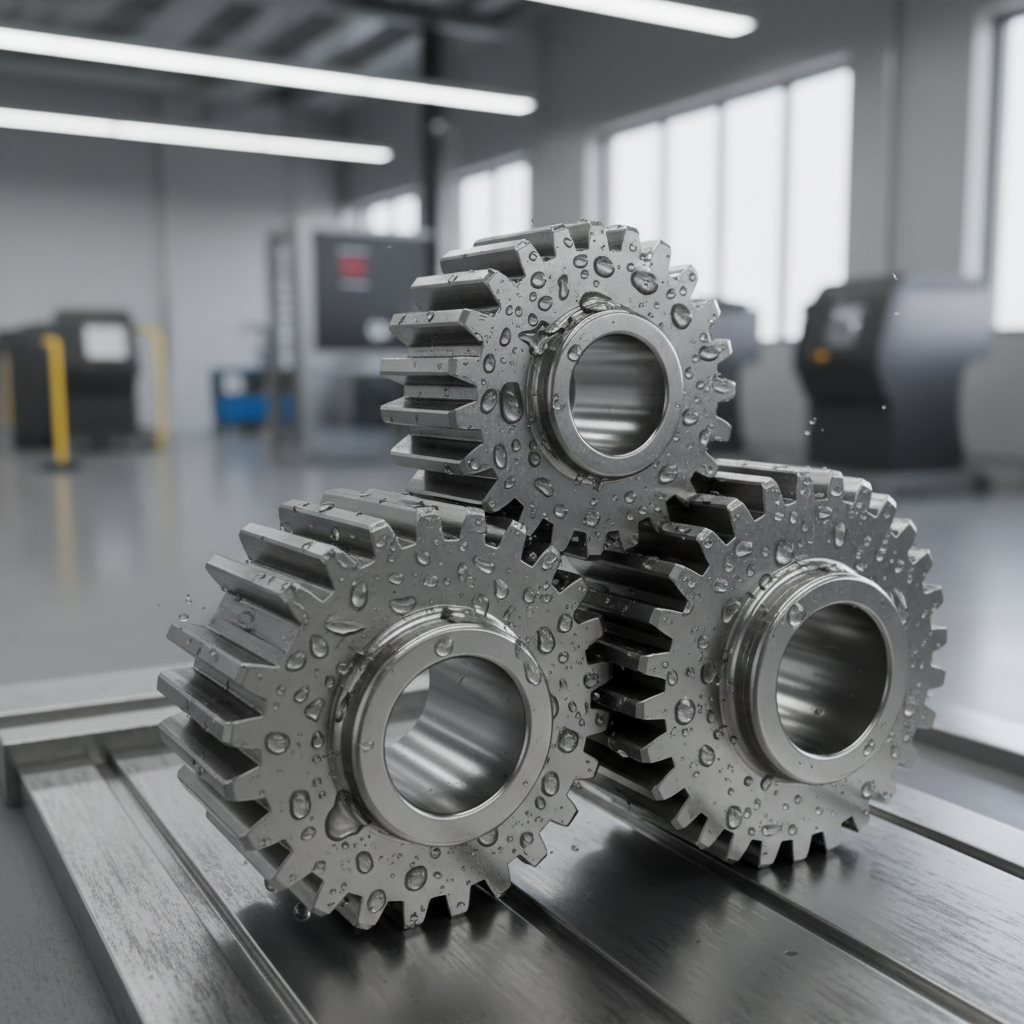
When does stainless steel pay for itself?
Look no further: the initial price premium is often offset by the lack of maintenance required. In damp or outdoor settings, a single stainless gear can outlast three carbon steel gears that have rusted through.
● High resistance to acids and moisture.
● Maintains strength at elevated temperatures.
● Clean appearance suitable for medical use.
Key Takeaway
Stainless steel is the economical choice for corrosive environments where standard steel would fail prematurely and cause downtime.
| Stainless Grade | Best Use Case | Budget Impact |
|---|---|---|
| 304 Grade | General Food Use | Moderate |
| 316 Grade | Marine Environments | Higher |
| 440C Grade | Hardened Bearings | High |
Comparing the long-term replacement frequency of different metals clarifies the true value of a stainless steel investment.
How does Acetal compare to other plastic spur gear materials?
Acetal provides superior dimensional stability and low moisture absorption for precise meshing in your drivetrain. It is often the preferred “engineering plastic” when you need tighter tolerances than what nylon can typically offer.
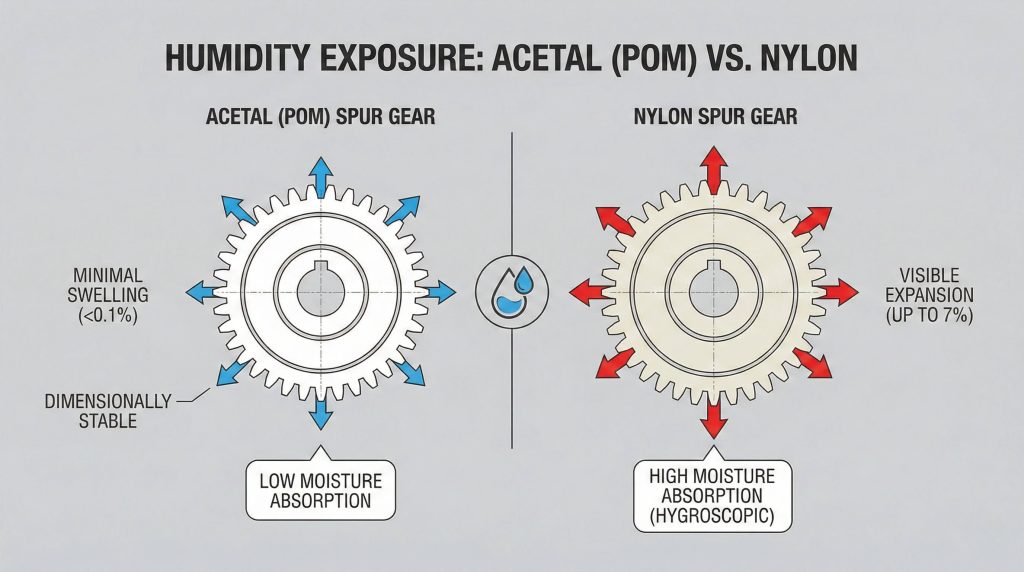
Why is moisture absorption a problem?
This is where it gets interesting… some plastics swell when they get wet, which ruins the gear mesh. Acetal stays the same size regardless of humidity, ensuring your gear teeth don’t bind or slip.
● High stiffness and mechanical strength.
● Excellent fatigue resistance over time.
● Low coefficient of friction for efficiency.
Key Takeaway
Acetal is the budget-friendly plastic choice for high-precision applications where dimensional accuracy is non-negotiable.
| Plastic Type | Moisture Absorption | Stiffness |
|---|---|---|
| Acetal (POM) | Very Low | High |
| Nylon 6/6 | Moderate | Moderate |
| Polyethylene | Low | Low |
Examining the humidity levels of your workspace will help you decide between nylon and acetal for plastic components.
Can standard sizing reduce costs for spur gear materials?
Choosing off-the-shelf dimensions avoids the massive premiums associated with custom tooling for your spur gear materials. Standard modules and pressure angles are produced in high volumes, driving the unit price down for everyone.
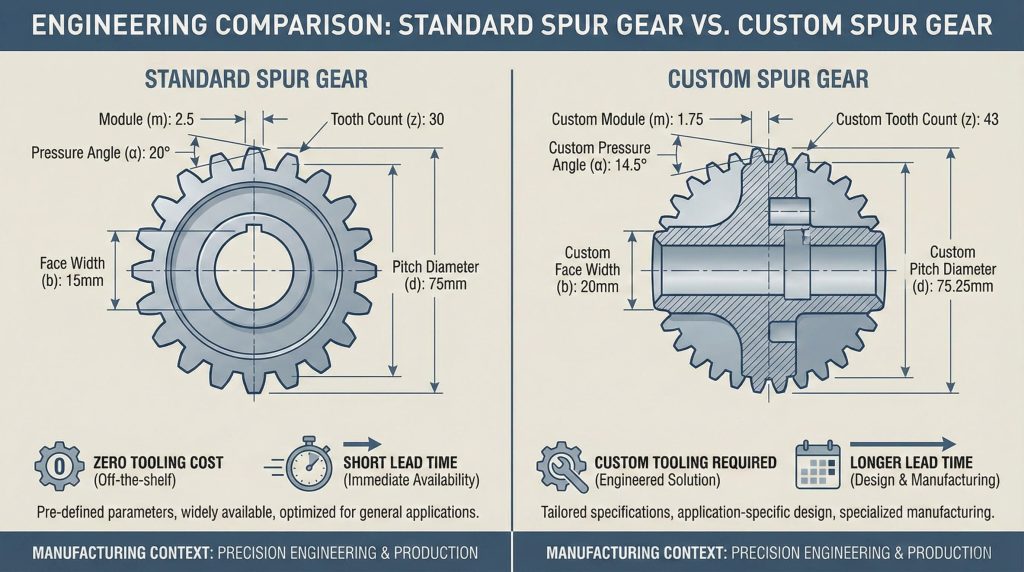
Why avoid custom gear geometry?
But here’s the kicker… a single custom hob can cost more than the entire production run of standard gears. Sticking to industry norms allows you to leverage mass production and skip expensive setup fees.
● Ready availability of replacement parts.
● No investment in custom cutting tools.
● Faster shipping and delivery timelines.
Key Takeaway
Standardization is the most effective way to reduce the cost of any gear material by leveraging existing manufacturing infrastructure.
| Design Type | Tooling Cost | Lead Time |
|---|---|---|
| Standard Gear | Zero | 1-2 Days |
| Custom Gear | High | 4-6 Weeks |
| Modified Standard | Low | 1-2 Weeks |
Aligning your design with common stock sizes is often more effective at saving money than switching materials.
Why is machining speed important for spur gear materials?
Materials with high machinability ratings reduce labor hours and overall manufacturing costs for your project. Labor is often the “hidden” expense that makes a cheap raw material surprisingly expensive in the final bill.
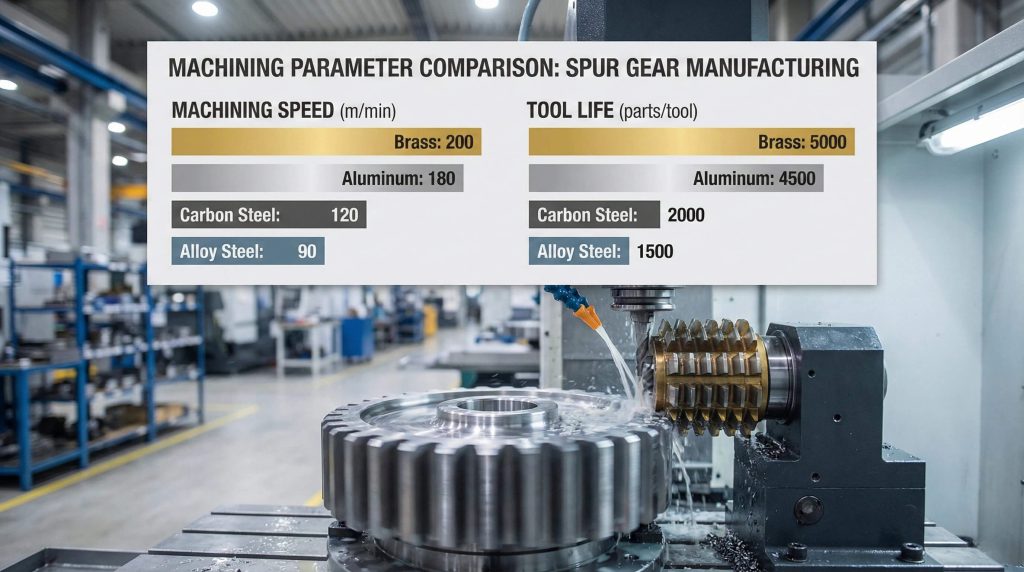
How does tool wear affect your price?
You might be wondering why some steels are cheaper than others despite similar raw prices. Harder materials wear down cutting tools faster, requiring more frequent tool changes and slower spindle speeds during production.
● Shorter cycle times per component.
● Longer lifespan for expensive cutting bits.
● Better surface finishes without extra steps.
Key Takeaway
Selecting a material that is easy to cut reduces both the time on the machine and the overhead of tooling.
| Material | Machining Speed | Tool Life |
|---|---|---|
| Brass | High | Very Long |
| Aluminum | High | Long |
| Alloy Steel | Low | Short |
Prioritizing materials with high machinability can slash your manufacturing budget even if the raw metal costs slightly more.
How do you maintain these affordable spur gear materials?
Regular lubrication and inspection prevent premature wear on cost-effective spur gear materials within your system. Maintenance is the insurance policy that keeps budget-friendly components running as long as their expensive counterparts.
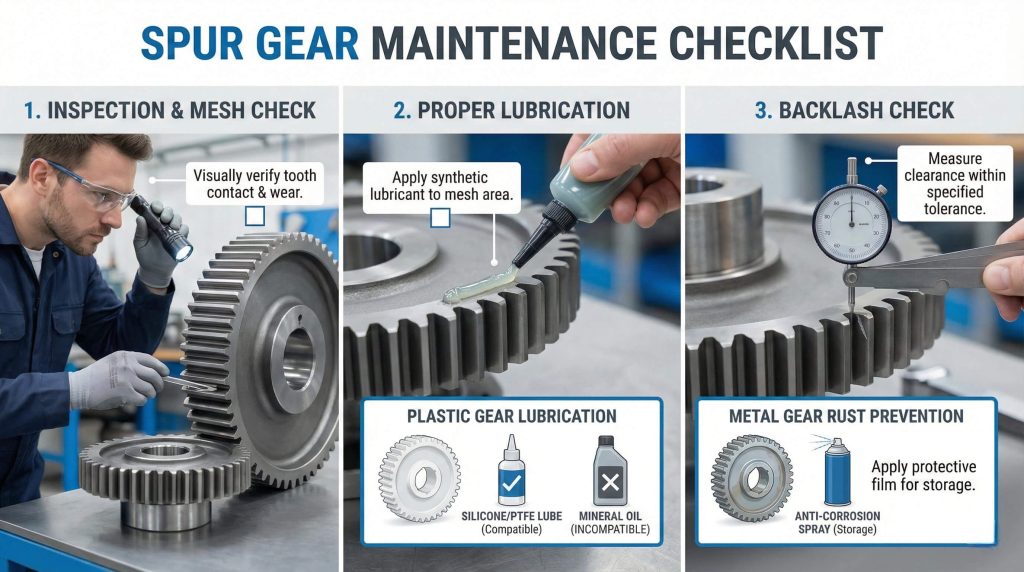
Does grease selection matter for plastics?
Wait, there’s more: using the wrong lubricant on plastic gears can actually dissolve the material over time. Choosing a compatible grease ensures that your budget-friendly Nylon or Acetal gears don’t fail early.
● Prevents friction-based heat buildup.
● Clears away debris that causes abrasion.
● Protects metal gears from surface rust.
Key Takeaway
A strict maintenance schedule extends the life of affordable materials, providing the best long-term value for your investment.
| Material Category | Primary Threat | Maintenance Fix |
|---|---|---|
| Metal Gears | Rust/Wear | Constant Lubrication |
| Plastic Gears | Heat/Binding | Proper Backlash |
| Cast Iron | Brittle Shock | Impact Damping |
Implementing a simple monthly inspection prevents small issues from turning into catastrophic and expensive gear failures.
Conclusion
Optimizing your project budget requires a strategic approach to selecting the right gear substrates. By utilizing Nylon, Carbon Steel, Cast Iron, and Brass, you can achieve professional-grade results without overspending on over-engineered alloys. We envision an industry where smart material selection empowers every engineer to build more for less. If you are ready to optimize your drivetrain and reduce manufacturing overhead, contact us today to discuss your specific design requirements with our expert team.
FAQ
Q1: Can I use Nylon gears for high-torque applications?
Judgment dictates that Nylon is generally not suitable for high-torque scenarios as it lacks the shear strength found in carbon steel. You should reserve polymers for light to moderate loads where noise reduction is the primary goal.
Q2: What’s the best material for a gear operating in salt water?
Brass or Stainless Steel represents the most reliable choice for marine environments due to their natural resistance to salt-induced oxidation. While Brass is often cheaper for small parts, Stainless Steel offers higher strength for structural components.
Q3: Can I mix different gear materials in the same drivetrain?
Mixing materials is actually a common engineering tactic, such as pairing a steel pinion with a nylon gear to reduce noise. This hybrid approach allows you to place strength where it is needed most while saving money elsewhere.
Q4: What’s the cheapest way to harden a budget steel gear?
Induction hardening is the most cost-effective method for increasing the surface durability of carbon steel spur gears. It targets only the tooth flanks, keeping the core of the gear ductile and the processing costs low.
Q5: Can I replace a cast iron gear with a steel one?
Yes, you can substitute steel for cast iron, though you must account for the loss of vibration damping. Steel gears may produce more noise in the system even if they offer higher overall tensile strength.